
Commercial and Property Managers
Rooftop Unit Replacement: Planning Guide for Building Owners
By John Gach, owner of Vantage Heating and Cooling · Published · Updated
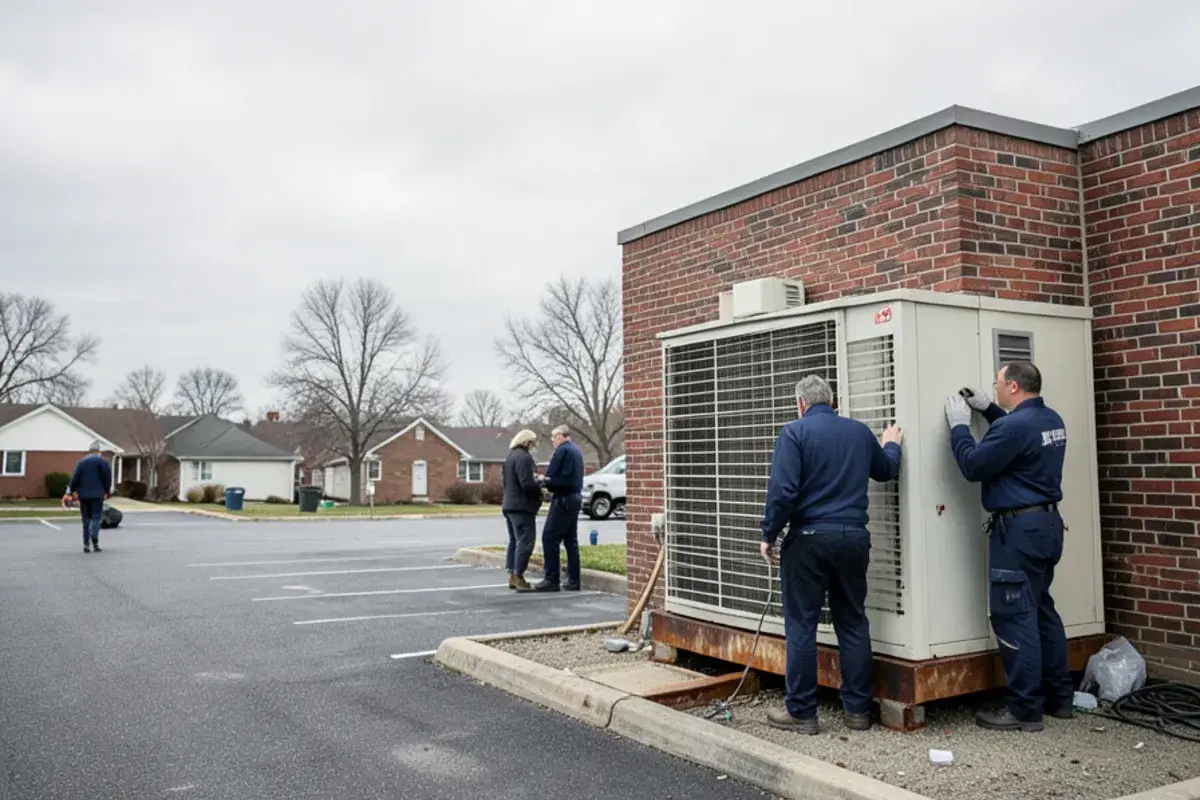
Rooftop unit replacement goes best when it is planned a season ahead: record what you have, price the replacement while the old unit still runs, and schedule the work for spring or fall. The expensive version is the emergency one, when a unit fails in January and every decision is made in a day.
This guide is educational and written for small building owners and property managers. Our business profile lists residential services, so please call to confirm we are the right fit for your building before you plan around us.
How do you know a rooftop unit is near the end?
Age is the first signal. YORK's replacement guidance gives a 15-year life expectancy for rooftop units, and industry studies land in a similar place. Climate, run hours and maintenance can move that either way.
The other signals are what you see and pay for:
- Repeated repairs. A second or third major repair in a couple of years.
- Compressor or heat exchanger problems. These are costly and usually signal the end.
- Rising energy use with no change in how the building is used.
- Comfort complaints that a tune-up does not fix.
- Corrosion on the cabinet, base or curb.
- Parts that are hard to find for an older model.
YORK reports that about 30 percent of rooftop replacements happen on an emergency basis. Planning ahead is how you stay out of that group.

What should you record before asking for quotes?
Collect the facts once, so every contractor quotes the same job:
- Make, model and serial number from the nameplate.
- Nominal size in tons and the heating type: gas, electric or none.
- What the unit serves, and how many hours a day it runs.
- Roof type, curb condition and whether there are other units nearby.
- Maintenance and repair records, if you have them.
- Your utility bills for a heating month and a cooling month.
A photo of the nameplate and a few photos of the curb and surroundings will save a site visit and a lot of guessing.
Will the new unit fit the old curb?
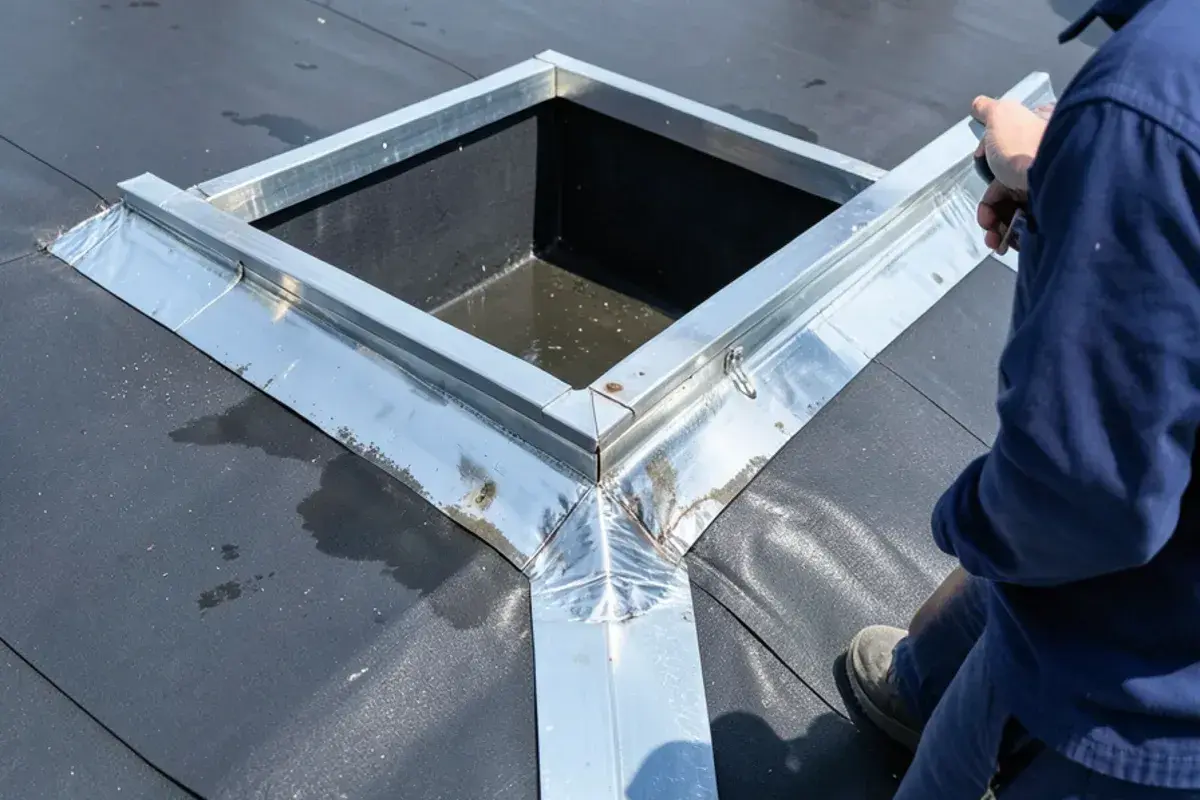
Not always. Manufacturers change footprints, and a new unit may not match the old one's mounting. An adapter curb bridges the existing curb or duct opening to the new unit's footprint, and avoids re-roofing when models or brands change. Adapter curbs are usually built to order for a specific unit, so confirm the lead time early. SMACNA's guidance on replacing rooftop units covers the curb and roofing details.
| Item to settle | Why it matters |
|---|---|
| Footprint and curb | Decides whether an adapter is needed |
| Weight and roof structure | The roof must carry the new unit and the lift |
| Gas, electrical and condensate connections | May need changes to match the new unit |
| Controls and thermostat compatibility | Old controls may not work with a new unit |
| Duct connections | Size and position must line up with the old openings |
| Refrigerant | Ask what the new unit uses; refrigerant handling requires EPA Section 608 certification |
Which efficiency rules apply to the new unit?
Federal efficiency standards for commercial package air conditioners and heat pumps follow the date a unit is manufactured. The Department of Energy says compliance with its most recent standards for air-cooled units at or above 65,000 Btu/h, which is about 5.4 tons, is required on and after January 1, 2029. Those standards use new metrics, called IVEC for cooling and IVHE for heat pump heating, in place of the older IEER rating.
For a building owner, the useful point is practical. Equipment built to a new standard can differ from the unit it replaces in weight, footprint and controls. Ask each contractor which standard the quoted unit is built to, its manufacture date if it is already in stock, and whether it changes the curb or the roof load. If you are replacing a unit in 2026 or 2027, the answer can be different from what it would be for the same job in 2029.
What belongs in a replacement quote?
Two quotes that look alike can price different jobs. Ask each contractor to list the following, so that you can compare line by line:
| Scope item | What to confirm |
|---|---|
| Unit | Make, model, size and heating type, with the manufacture date |
| Curb | New curb, adapter curb or reuse, and who builds and flashes it |
| Crane or lift | Included, and who handles street or parking permits |
| Electrical | Disconnect, wire size and breaker, if changed |
| Gas and condensate | Any change to piping, the drain route or the heat exchanger venting |
| Controls | Thermostat or building controls, and demand ventilation if you need it |
| Economizer | Whether the unit has one and whether it is wired and tested |
| Start-up | Commissioning, readings recorded and a report left behind |
| Old unit | Removal, disposal and refrigerant recovery |
| Roof | Who repairs any roofing disturbed by the work |
SMACNA's article on replacing rooftop units describes one contractor's experience that about 90 percent of the time a replacement involves a curb adapter. That is one contractor's figure, not a rule, but it supports the point that you should expect to price an adapter and confirm the lead time.
Who protects the roof?
The roof is often the most expensive part of the building, and a rooftop unit swap disturbs it. Before anyone cuts or lifts, ask your roofer or read your roof warranty to learn whether work by another trade can affect it. A mismatch between curb and roof, or a flashing detail done badly, leaks long after the unit is set.
SMACNA's article on a school replacement shows how site conditions can drive the design: on an older standing seam roof, a factory curb would not work, and the contractor built custom curbs and added structural support below the roof. Not every building needs that, but ask for the roof to be looked at before the quote is final, and ask whether the contractor will coordinate with your roofer.
What happens on replacement day?
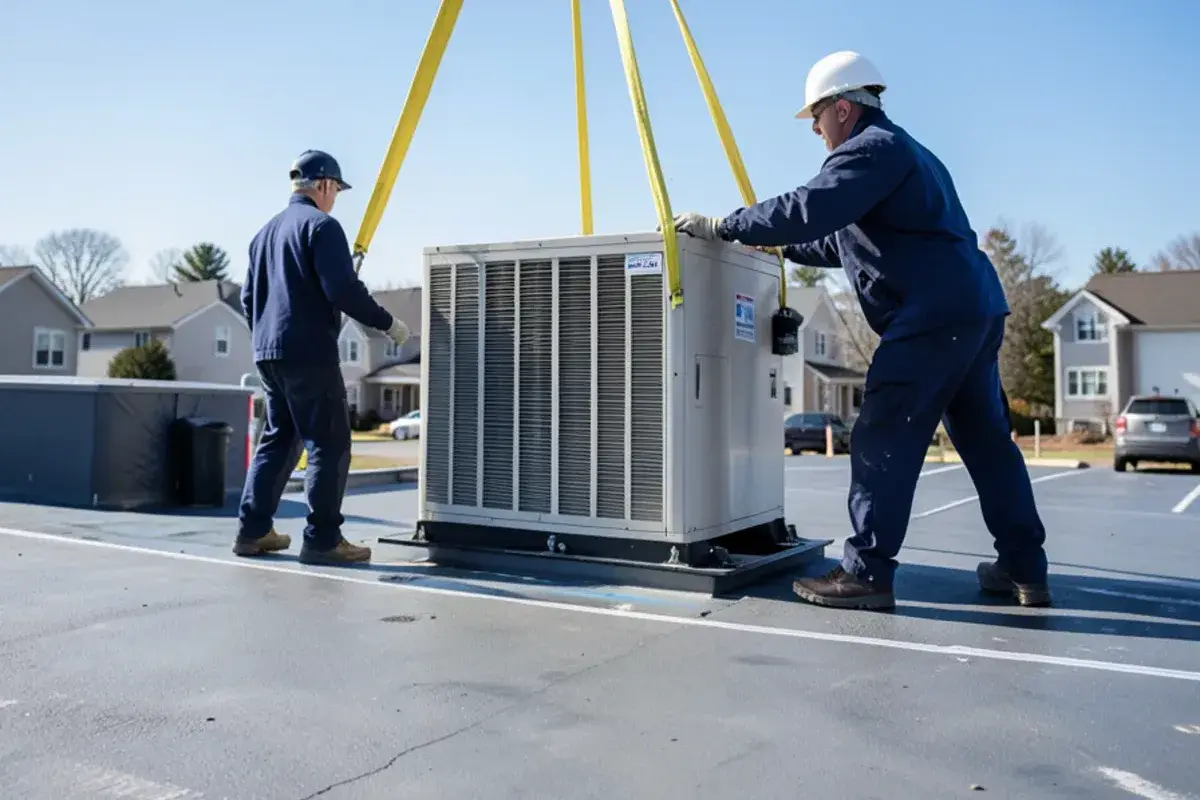
Most rooftop replacements involve a crane or lift, so the day needs planning. Expect to coordinate the lift path, a staging area, road or parking closures if needed, and a plan for the old unit. Disconnect and reconnect work on gas, electric, controls and duct takes time too.
Tell tenants and staff ahead of time. Ask the contractor how long the building will be without conditioned air, and what the plan is if weather stops the lift. Permits and inspections vary by municipality, so ask the contractor who pulls them and check with the local building department yourself.
When should you schedule it?
Spring and fall are easiest. The building needs little heating or cooling, and a day or two without the unit is manageable. Buffalo averages about 6,466 heating degree days a year according to NOAA, so a winter failure is not a small problem, and the heating season runs long. A January replacement is possible, but snow, ice and short days all make roof work harder.
If you manage several units, consider replacing them in order of age and condition across more than one season, so the budget and the disruption are spread out.
How do you budget for several units over time?
If you own a building with more than one rooftop unit, a short table turns maintenance records into a replacement plan:
| Unit | Age | Repairs in last 3 years | Condition notes | Plan |
|---|---|---|---|---|
| RTU-1 | Note the install year | Count and rough cost | Corrosion, curb, compressor | Replace, repair or watch |
| RTU-2 |
Rank units by age and by the cost of repairs. Spread the oldest and worst across seasons so that a single year does not carry the whole bill. Our preventive maintenance checklist for property managers explains the records that feed this table. Ask your electric and gas utilities whether any commercial incentive programs apply to your building before you order equipment, and do not assume that residential programs carry over.
How we approach a rooftop unit question
We start from the building and its history, not from a product. A site look tells us the size and condition of what is there, the curb, the roof access and the connections. We then describe the options in plain terms: repair, replace like for like, or change the size or type if the building has changed.
We give a clear quote before work starts, and we expect you to compare it with others. If the unit is still worth repairing, we say so, even though that is the smaller job. Our rooftop unit service page explains what we look at, and our commercial HVAC maintenance page covers upkeep that can extend a unit's life.
Check the fit for your building
Gather your nameplate details and records, then call (321) 666-8870. If your building is in or near Amherst, tell us where it is and what the unit serves, and we will say honestly whether we are the right fit. If a unit has already failed, ask about commercial HVAC repair as well.
Quick answers
How long does a rooftop unit last?
Manufacturer replacement guidance and industry studies commonly put the useful life of a rooftop unit at around 15 years. Climate, how hard the unit works and how well it has been maintained all move that number. Age alone is not a replacement trigger, but it is a reason to start planning and budgeting.
What is the right time of year to replace a rooftop unit?
Usually in the shoulder seasons, spring or fall, when the building needs little heating or cooling and a day or two without the unit is easier to manage. Replacing in the middle of a Buffalo winter or a July heat spell is possible but harder, and it limits your options if the work has to be rescheduled.
Can you replace our rooftop unit?
Most of our work is residential, so we take small commercial questions building by building. Call (321) 666-8870 and tell us the unit size, the building and its location. We will say honestly whether we are the right fit before you plan around us.
Sources
- YORK, Core Rooftop Replacement: the right fit (life expectancy and planned vs emergency replacement)
- SMACNA, HVAC: Replacing Rooftop Units
- U.S. Department of Energy, Air-Cooled Unitary Air Conditioners and Heat Pumps (standards for units 65,000 Btu/h and above; compliance January 1, 2029)
- U.S. EPA, Section 608 refrigerant certification
- NOAA 1991-2020 climate normals for Buffalo, NY: heating degree days